
Global building operations account for nearly 37% of energy-related carbon dioxide emissions, according to the United Nations Environment Programme and the International Energy Agency. A significant portion of this energy use is tied to heating and cooling demands influenced by how buildings interact with outdoor conditions.
These pressures are reshaping how architects approach exterior spaces, especially in residential design. Homes are no longer planned as static shelters but as responsive systems that adapt to shifting sunlight, heat, and airflow. One emerging solution is the integration of modular shading systems such as the bioclimatic pergola or the bioklimatska pergola, a design approach highlighted by PergoMaxx as part of a broader shift toward climate-sensitive outdoor living environments. These structures reflect a growing architectural interest in controlling microclimates without relying heavily on mechanical cooling.
The challenge of climate variability in residential environments
Rising global temperatures and irregular weather patterns have made outdoor comfort harder to maintain. Research from the IPCC Sixth Assessment Report notes that urban heat intensity is increasing, particularly in densely built environments where heat retention is amplified by concrete and glass surfaces.
Traditional patios, terraces, and balconies often fail to provide stable comfort throughout the year. Direct sunlight in summer can make outdoor areas unusable, while colder months limit their function entirely. This inconsistency has pushed architects to rethink the boundary between interior and exterior space. The problem is not simply exposure, but the lack of adaptable environmental control in residential layouts.
Adaptive shading systems as a design response
Modern architecture increasingly relies on adaptive shading systems to manage solar gain and airflow. These systems range from motorized louvers to retractable roofing structures that adjust based on weather conditions. Unlike fixed roofs or static awnings, they respond dynamically to environmental change.
The U.S. Department of Energy has long emphasized the role of passive cooling strategies in reducing residential energy demand. Adjustable shading elements help reduce reliance on air conditioning by limiting heat gain before it enters interior spaces. In many cases, this approach can lower cooling loads while improving comfort in adjacent indoor rooms.
Materials also play a role. Aluminum frames, thermally broken profiles, and weather-resistant finishes allow these systems to function year-round. When integrated properly, they become part of the building envelope rather than an external accessory. This integration marks a shift in how outdoor areas are conceived, from decorative extensions to functional climate buffers.
Integration of climate-responsive pergolas in modern residential planning
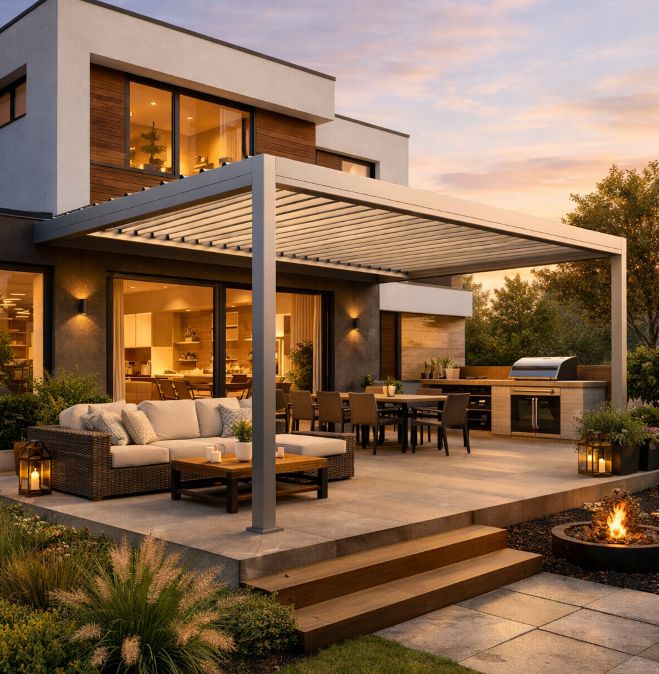
Within this evolving framework, climate-responsive pergolas have become a key architectural element. They operate through adjustable slats or rotating louvers that regulate sunlight, ventilation, and rain protection. By controlling these variables, they create semi-outdoor environments that remain usable across seasons.
Design studies referenced by McKinsey Global Institute on urban living trends highlight that homeowners are increasingly valuing flexible spaces that can transition between open-air and enclosed conditions. This has influenced residential architects to incorporate shaded outdoor rooms as functional extensions of living areas rather than secondary features.
In practice, these structures often sit between the house and the garden, forming a transitional zone. When open, they encourage airflow and natural daylight. When closed, they provide shelter and thermal protection. This dual behavior supports both environmental performance and lifestyle adaptability.
The concept aligns closely with bioclimatic design principles, where architecture responds directly to local climate conditions. Instead of resisting weather, the structure works with it. As a result, outdoor living spaces become more stable, efficient, and comfortable without excessive energy consumption.
Spatial and environmental implications for residential architecture
The integration of adaptive outdoor structures is reshaping spatial planning in modern homes. Architects now consider exterior shading systems during the early design phase rather than as later additions. This shift improves both energy performance and spatial continuity.
In warmer regions, these systems reduce surface overheating and support natural ventilation. Discussions on show how structural precision and architectural design increasingly intersect in creating energy-efficient envelopes. In temperate climates, they extend the usability of outdoor areas across more months of the year. The result is a more fluid relationship between indoor and outdoor living zones.
Environmental performance is also improved at a broader scale. By reducing heat gain and supporting passive cooling, these systems contribute to lower overall energy consumption. Studies from the World Green Building Council indicate that passive design strategies can significantly reduce operational energy use in residential buildings when applied consistently.
Looking ahead, climate-responsive architecture is likely to become a baseline rather than a specialty. As housing demands increase and climate conditions become more unpredictable, the need for adaptable building envelopes will grow. Outdoor structures that respond to sunlight, airflow, and temperature will play a central role in this transformation.
Ultimately, the evolution of residential design reflects a deeper shift in architectural thinking. Homes are no longer isolated objects but active participants in their environment. Through the careful integration of adaptive shading systems and bioclimatic outdoor solutions, architecture is moving toward spaces that are more responsive, efficient, and aligned with natural conditions.
Tags: climate-responsive architecture, bioclimatic design, adaptive shading systems, residential architecture, sustainable housing
Image prompt suggestions:
- Modern house with adjustable louvered pergola over terrace, warm natural lighting, architectural visualization
- Cross-section diagram of climate-responsive outdoor shading system showing airflow and sunlight control
- Minimalist residential courtyard with bioclimatic outdoor structure and integrated greenery
- Before and after comparison of shaded vs unshaded outdoor living space in summer heat
- Architectural blueprint style rendering of adaptive pergola integrated into home design